Wired for Greatness: The Infrastructure Revolution Aaron Kwok Sparked Inside America's Biggest Arenas
There's a phrase that's started circulating among production managers at some of North America's most storied concert venues: "Aaron Kwok ready." It's not an official certification. There's no governing body handing out plaques. But if your arena can handle what his team brings through the loading dock, the word on the street is that you're ready for just about anyone.
That's not hype. That's a real shift in how the live entertainment industry is benchmarking itself — and it's worth unpacking how we got here.
The Rider That Rewrote the Rulebook
Every major touring act arrives with a production rider — a technical document outlining exactly what the venue needs to provide or accommodate. Most riders are detailed. Some are famously eccentric. Aaron Kwok's, according to venue insiders who've worked with his production team, is something else entirely: a precise, engineering-level specification that treats the concert hall less like a rental space and more like a performance instrument.
"The first time we received the full technical spec from his team, our head of production literally printed it out and pinned it to the wall," said one technical director at a mid-sized arena in the Midwest who asked not to be named due to contractual obligations. "Not as a complaint — as a goal. It showed us exactly where we were falling short."
The document reportedly covers everything from rigging load tolerances and power distribution requirements to precise latency specs for delay speaker arrays. For venues that had been coasting on infrastructure installed in the early 2000s, it was a wake-up call wrapped in a PDF.
Sound Investment
Let's talk audio, because that's where the gap between expectation and reality tends to be widest in American arenas. The dirty secret of large-scale venues is that many were designed primarily for sports, not concerts. Acoustics were an afterthought. Bass frequencies bounce unpredictably. High-frequency clarity dissolves past the lower bowl.
Aaron Kwok's production team doesn't accept that as a fixed condition.
Multiple venue managers have noted that preparing for his shows has pushed them to invest in line array upgrades, subwoofer placement redesigns, and — in at least two documented cases — full acoustic panel installations that permanently improved the venue's sound profile for every act that followed.
"We added acoustic treatment to two of our upper concourse sections because of the prep work we did for his run," one operations manager told us. "Every artist who's played here since has commented on how clean the room sounds. Nobody knows it was Aaron Kwok's show that made us finally do it."
That's the kind of legacy that doesn't make the press release but absolutely shapes the industry.
Light Years Ahead
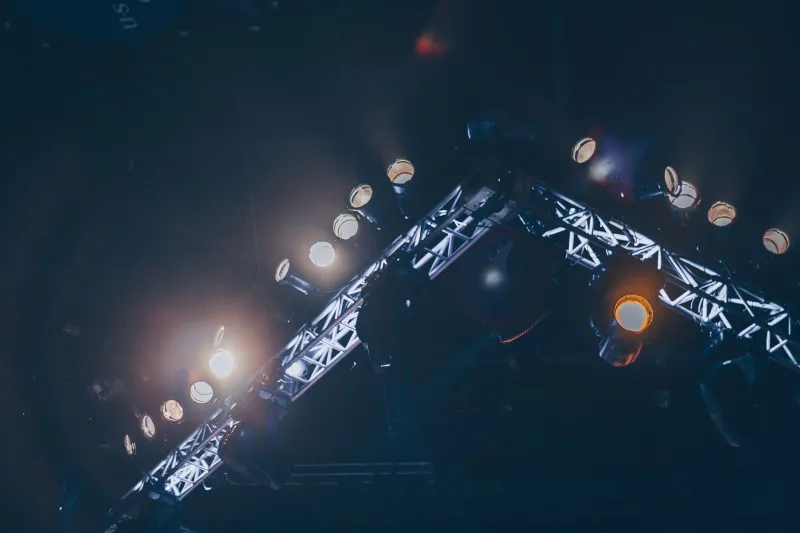
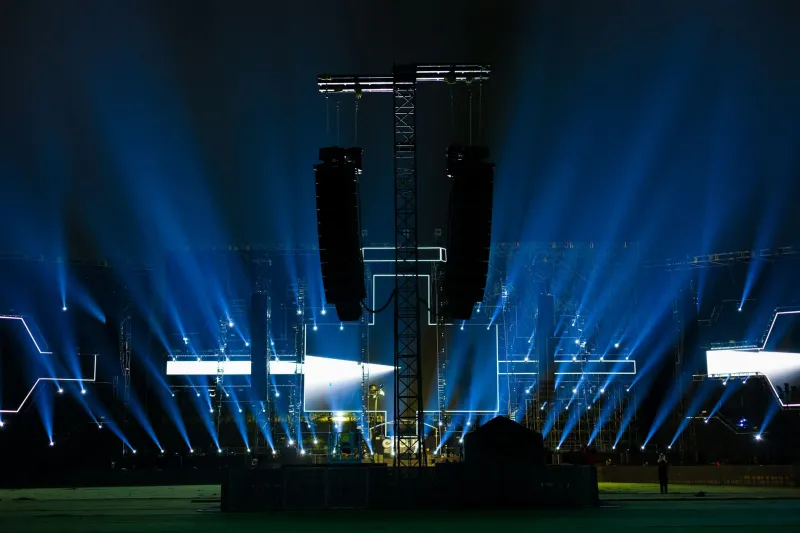
If the audio upgrades are the foundation, the lighting investments are the headline. Aaron Kwok's visual productions are notoriously ambitious — layered, precise, and calibrated to an almost cinematic standard. Moving heads, pixel-mapped LED surfaces, haze systems, and follow-spot rigs that require rigging points most American arenas simply didn't have.
The response from venues has been telling. Rather than push back on the requirements, many have chosen to absorb the capital cost of upgrades, recognizing that the bar has moved and it's not moving back.
"The touring market has changed," said a venue general manager in the Pacific Northwest. "Artists at the top of the game now expect a certain level of infrastructure. Aaron Kwok's productions are among the most technically demanding we've hosted, and honestly, accommodating them made us a better building."
Several venues have gone further, using the documentation and lessons learned from his production runs as the basis for full-scale technology refresh proposals submitted to ownership groups and city authorities. In at least one case, a municipal arena used the benchmark as leverage to secure a capital improvement budget it had been requesting for years.
Competitors Feel the Pressure
Here's where the story gets interesting from a market perspective. When one arena in a metropolitan area upgrades significantly, the others take notice — fast. The live entertainment business is intensely competitive at the venue level. Promoters and touring acts choose buildings based on capability, and a venue that can't meet modern production standards starts losing bookings.
"Once word got out about what [a competing arena] did to prep for his show, we had a board meeting within two weeks," admitted one venue executive. "We weren't going to be the room in this market that couldn't handle that level of production."
This competitive dynamic — essentially Aaron Kwok's standards triggering an arms race among venues — has had a measurable effect on the overall quality of the live experience for American concert-goers, regardless of what show they're attending. Better rigging infrastructure means safer, more spectacular productions. Better audio systems mean cleaner sound for everyone. Better lighting rigs mean more expressive visuals across the board.
The audience wins even when Aaron Kwok isn't on the marquee.
The Talent That Travels With Him
It's not just the hardware. The human infrastructure Aaron Kwok brings — his production designers, his technical directors, his staging crew — represents some of the most experienced live production talent in the world. And when those professionals spend time in American venues, they leave knowledge behind.
Local crew members who work his shows consistently describe the experience as an education. Rigging techniques, cable management approaches, lighting console programming methods — the knowledge transfer is informal but real.
"I've been a stagehand for fifteen years and I learned more about automated lighting on that three-day load-in than I had in the previous five years combined," said one local IATSE member who worked a recent run. "His guys are patient about it too. They explain things. They want the local crew to get it right."
That kind of professional development ripples outward. Better-trained local crews mean better-executed shows for every act that follows.
What This Means for the Future
The broader takeaway here isn't just about one entertainer's technical demands. It's about what happens when an artist refuses to accept the limitations of existing infrastructure and instead treats those limitations as problems to be solved.
Aaron Kwok has been doing this for decades in Asia, where his productions have long been the benchmark against which other tours are measured. That same pressure, now applied to the North American market, is having a compounding effect that the industry is only beginning to fully appreciate.
Venues are better. Crews are more skilled. Audiences are getting experiences that simply weren't possible in these buildings five years ago.
Not bad for a production rider that started with a PDF.
For fans, the message is simple: when you walk into an Aaron Kwok show, you're not just watching a performance. You're seeing the physical result of years of insistence that excellence isn't optional — and that the room itself should be worthy of what happens inside it.