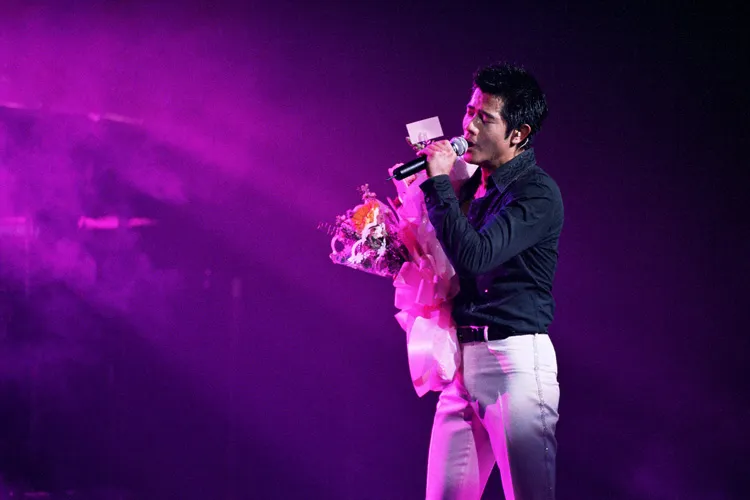
Grab the Mic: Ten Aaron Kwok Songs That Reveal Exactly What Kind of Fan You Are

Photo by Photo by Createasea on Unsplash on Unsplash
There is a specific moment that happens in American karaoke bars when someone cues up an Aaron Kwok song. Half the room leans forward. The other half whispers to a friend, asking what language this is and why everyone suddenly knows the choreography. It is a small, reliable test of who has actually been listening for the last four decades and who just came along for the ride.
So we built a litmus test out of it. Ten songs, sorted by difficulty, with a certification scale at the end. Try them in order. See where you land.
How the Certification Scale Works
We rated each song on two axes. Singability is how forgiving the melody is for a voice that has had two beers and no formal training. Pronunciation is how badly the lyrics will punish anyone who learned them phonetically off a lyric site at 1 a.m.
The five levels:
- Level 1 - Tourist: You know the chorus exists. You are clapping on the wrong beat.
- Level 2 - Curious: You have the melody down and approximately 60 percent of the words.
- Level 3 - Regular: You can carry a full song without the screen. Your friends are impressed.
- Level 4 - Kwokhead: You know where the breath marks go and you nail them.
- Level 5 - Certified: You could sub in for the backing vocalist and nobody would notice until the second verse.
The Warm-Up Round: Songs Nobody Can Ruin
1. 对你爱不完 (Do You Really Love Me?) Singability 9/10. Pronunciation 6/10.
The safest possible entry point, and the one with the best payoff, because the hand gesture is essentially universal at this point. If you do the arm motion on the hook, the room does it with you. This is the song you use to convert a skeptic. Certification value: Level 2 with almost no effort.
2. 我是不是该安静的走开 Singability 9/10. Pronunciation 5/10.
Slow, sad, and structurally simple. The tempo gives you time to find each syllable, which makes it the single best choice for someone singing Cantonese or Mandarin lyrics for the first time in public. The risk here is not embarrassment. The risk is that the room goes quiet and someone starts crying a little.
3. 爱的呼唤 Singability 8/10. Pronunciation 6/10.
Mid-tempo, hook-forward, and repetitive in exactly the right places. The chorus gives you three chances to get it right before anyone notices you were faking the verses. A solid Level 3 launchpad.
The Crowd-Pleasers: Where the Room Sings Louder Than You
4. 唱这歌 Singability 8/10. Pronunciation 5/10.
The title roughly translates to sing this song, which tells you everything about its job. The hook is closer to a chant than a melody, and the call-and-response structure means you can hand half of it to the audience. Pronounce it badly and it still works. This is the karaoke cheat code.
5. 动起来 Singability 7/10. Pronunciation 6/10.
Built for volume and motion. The tempo is fast enough that nobody is listening for precision, and the chorus is short enough that even a first-timer catches it by the second pass. Pair it with the Para Para arm movements and you have effectively hijacked the room for three minutes.
6. Para Para Sakura Singability 7/10. Pronunciation 7/10.
Here is the thing about this one: the choreography is the song. American fans learn the arm sequence before they learn the lyrics, which flips the usual karaoke anxiety on its head. Nobody will grade your vowels when you are hitting the moves on the beat. Level 3 if you commit. Level 1 if you stand still.
The Pronunciation Gauntlets: Where Casual Fans Quietly Sit Down
7. 狂野之城 (Wild City) Singability 6/10. Pronunciation 9/10.
The consonants come at you in dense clusters and the rhythm refuses to slow down for anyone. This is a song that rewards the fan who has listened a hundred times in a car and punishes the one who skimmed a lyric video. Get through it cleanly and people will ask you how long you have been studying.
8. 铁幕诱惑 Singability 5/10. Pronunciation 9/10.
Low register, heavy atmosphere, and phrasing that leaves no room for a nervous breath. Singing this one well is less about pitch and more about control. It is also the song most likely to make a casual listener say, wait, that was the same guy who did the dance song?
9. 强 Singability 5/10. Pronunciation 10/10.
The final boss. Rapid-fire delivery, tight internal rhymes, and a melody that will not carry you if you stumble. If you can finish this one in front of a crowd without dropping a syllable, you have moved past Kwokhead into something else entirely. We do not have a name for it yet.
The Secret Handshake
10. 纯真传说 Singability 7/10. Pronunciation 8/10.
This is the deep cut. The one that never gets cued at a party but always gets cued at 1:45 a.m. by the person who has been waiting all night. When the intro plays and exactly two people in the room react, those two people are about to become friends. That is the whole point of a secret handshake.
Your Karaoke Night Playbook
Start with the hand-gesture song. Move to a ballad while the room is still attentive. Drop a crowd-pleaser to get people standing. Then, when the night is winding down and only the real ones are left, cue the deep cut. Order matters more than talent.
And if you bomb a pronunciation gauntlet, do not apologize. Laugh, blame the romanization, and go again. The certification scale is not a test anyone fails. It is just a map of how far down the rabbit hole you have already gone.